Website
 Optimisation
 Support
 Training
 Blog
 db8
 Portfolio
 Reviews


Joomla World Conference 2026 in Potsdam: three days with the Joomla community
Last weekend (Friday 16 to Sunday 18 October 2026) I went to the Joomla World Conference 2026 in Potsdam, close to Berlin in Germany. The conference was held at the Kongresshotel Potsdam, with four rooms running in parallel: two rooms mainly in English and two rooms mainly in German.
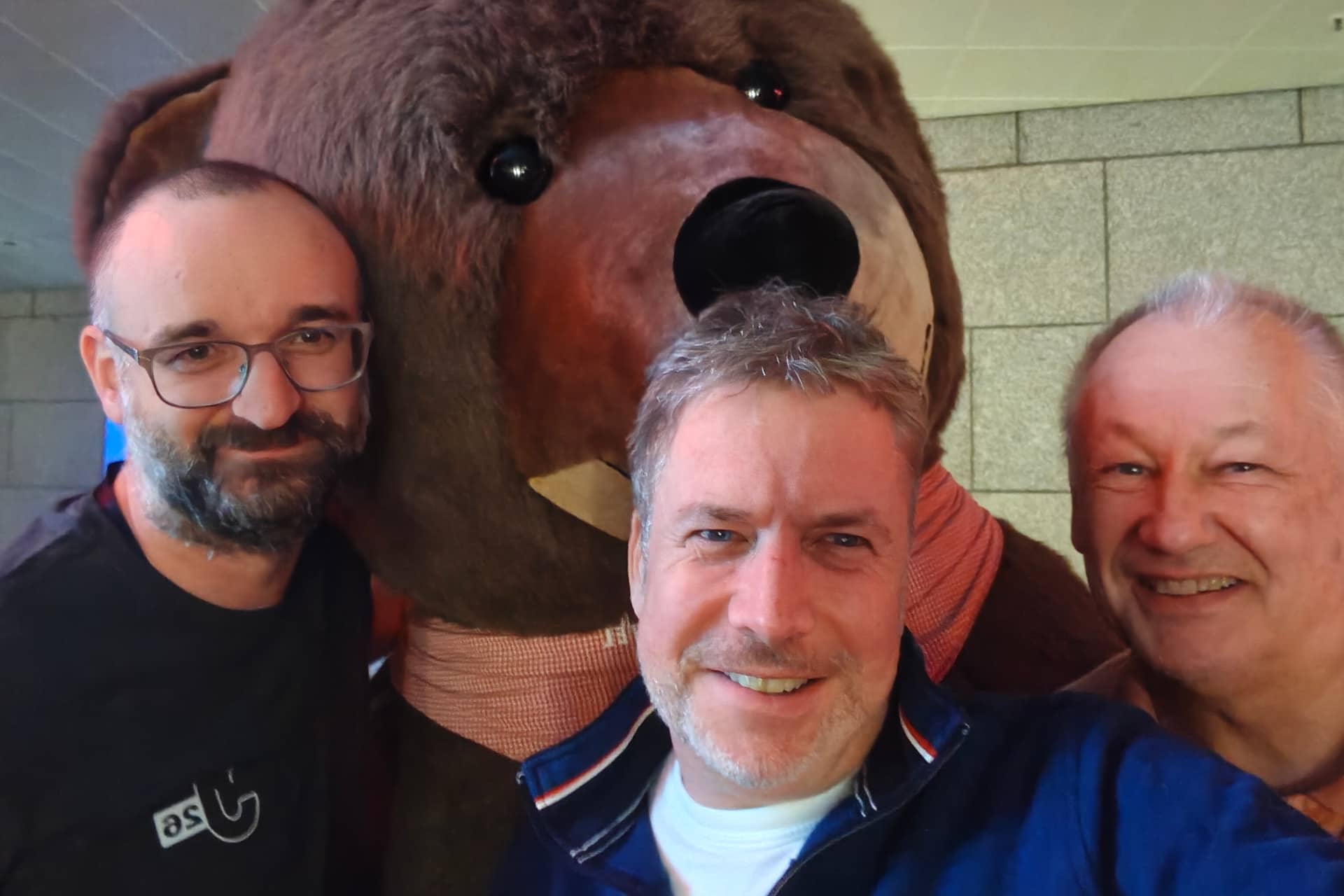
We had three very nice days. I met a lot of Joomla friends, and also many people that I had not met before. There were good conversations everywhere: in the sessions, in the hallways, during lunch and in the evening. The atmosphere was friendly and open, as it usually is with the Joomla community.
Thursday: bowling and dinner
On Thursday evening, before the conference started, we had dinner at a bowling alley/restaurant close to the venue. Good food and nice conversations, a relaxed way to start the event.
There was a funny side story. The weekend before the conference I had a look at the website of that bowling alley/restaurant and thought: "that could be better". So I created a copy of their website with Joomla and YOOtheme Pro. It turned out I was not the only one with that idea: two other Joomla website builders had also made an improved version. Just because we can :-). I think this says something about the Joomla community. We just like building websites, trying new things and sharing what we made with each other.
Friday
Friday was the first full conference day. With four rooms in parallel, in English and German. Somtimes it was difficult to choose but here are the sessions that I attended.
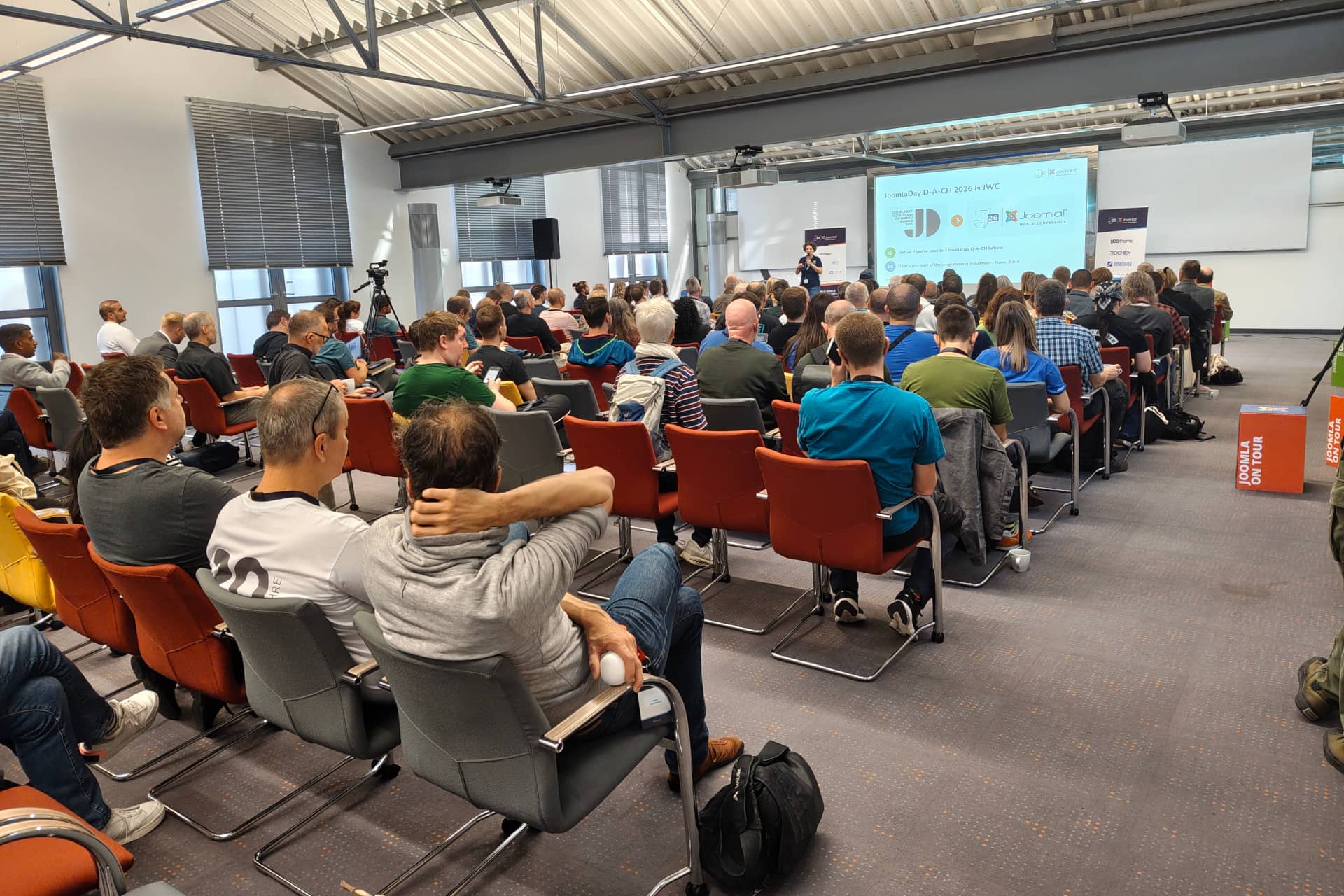
Keynote: It's all about the (YO)U – Elisa Foltyn
Elisa, President of Open Source Matters, opened the conference with a keynote about what an American football team called the "Unicorns" can teach us about open source. A good start of the day about teamwork, and about the role every single person has in a community.
Vertrauen ist das neue Ranking – Tobias Meschkat (German)
Tobias talked about how websites can become a source that AI tools like ChatGPT and Gemini will quote. According to him, Google's AI Overviews already cost German-language websites more than 250 million clicks per month. He shared practical tactics such as a Grounding Page, a single webpage that provides reliable, machine-readable information about your brand or business for AI and search engines. And he talked about "chunking" content, matching search intent and using listicles, with real numbers and a checklist.
Web Services API: Implementation for components – Thomas Finnern
Thomas, who built the image upload API for JoomGallery, explained how to add Joomla Web Services API support to your own component. He showed the minimum code you need, how to use the component's controllers and models, how to adjust data before it is processed, and how to prepare the JSON response. Very useful for extension developers.
Weniger klicken, mehr schaffen mit und ohne KI – Automatisierung im Büroalltag – Steffi Krüger (German)
Steffi showed how to automate everyday office work step by step, with and without AI. She showed how small tasks can take up a lot of time. Five minutes here, three minutes there. Add up the time, multiply it by your hourly rate and calculate the yearly costs. You might be surprised! Her message was to first understand your existing processes and remove unnecessary steps, and only then connect the digital tools you already use. Small changes can save a lot of time.
Keynote: An exploit a day keeps... us busy? – Joomla Security in the AI age – David Jardin
David, team leader of the Joomla Security Strike Team, talked about the strong increase of security issues in 2026, both in Joomla core and in third-party extensions. Artificial intelligence makes it easier to find vulnerabilities, and that puts pressure on developers, site owners and the project. He explained what is driving this and what we as a community can do to keep up.
Why Joomla website builders should know a bit of Linux – Peter Martin
This was my own presentation. Many Joomla professionals only use cPanel, Plesk and/or FileZilla to manage their sites. I explained some Linux basics (the kernel, SSH, the filesystem, permissions and ownership) and showed how small tools like grep, rsync and Docker can save you a lot of time when you migrate, debug or maintain Joomla websites. Even to check if a site was hacked.
I also brought something from the Netherlands: six chocolate letters that together formed the word JOOMLA. In the Netherlands we have a tradition to give someone a chocolate letter with the first letter of their name for Sinterklaas. I gave three letters to people who asked interesting questions during my presentation, and the other three to other attendees.
TUF for extension developers – Rüdiger Schultz
The Update Framework (TUF) is already used in Joomla core to make updates more secure. Rüdiger presented early ideas to make TUF also available for third-party extension developers, and explained its architecture and trust model. Because the concept is still in an early stage, he asked the audience for feedback.
Extension Sponsors
In this session five extension developers talked about sponsoring the Joomla project: Abdulgani Tumbi (joomconsultant.com), Yannick Gaultier (weeblr.com), Thomas Foucher (acymailing.com), Manuel Häusler (joomgalleryfriends.net) and me (db8.nl). It is nice to see that extension developers give something back to the project that their business depends on.
In the evening we had the conference dinner, with PPT-oke and the J!Awards. A fun evening with good food and many nice conversations.
Saturday
Saturday started with a keynote and some technical sessions. In the afternoon the conference changed from listening to presentations to actually working together on Joomla.
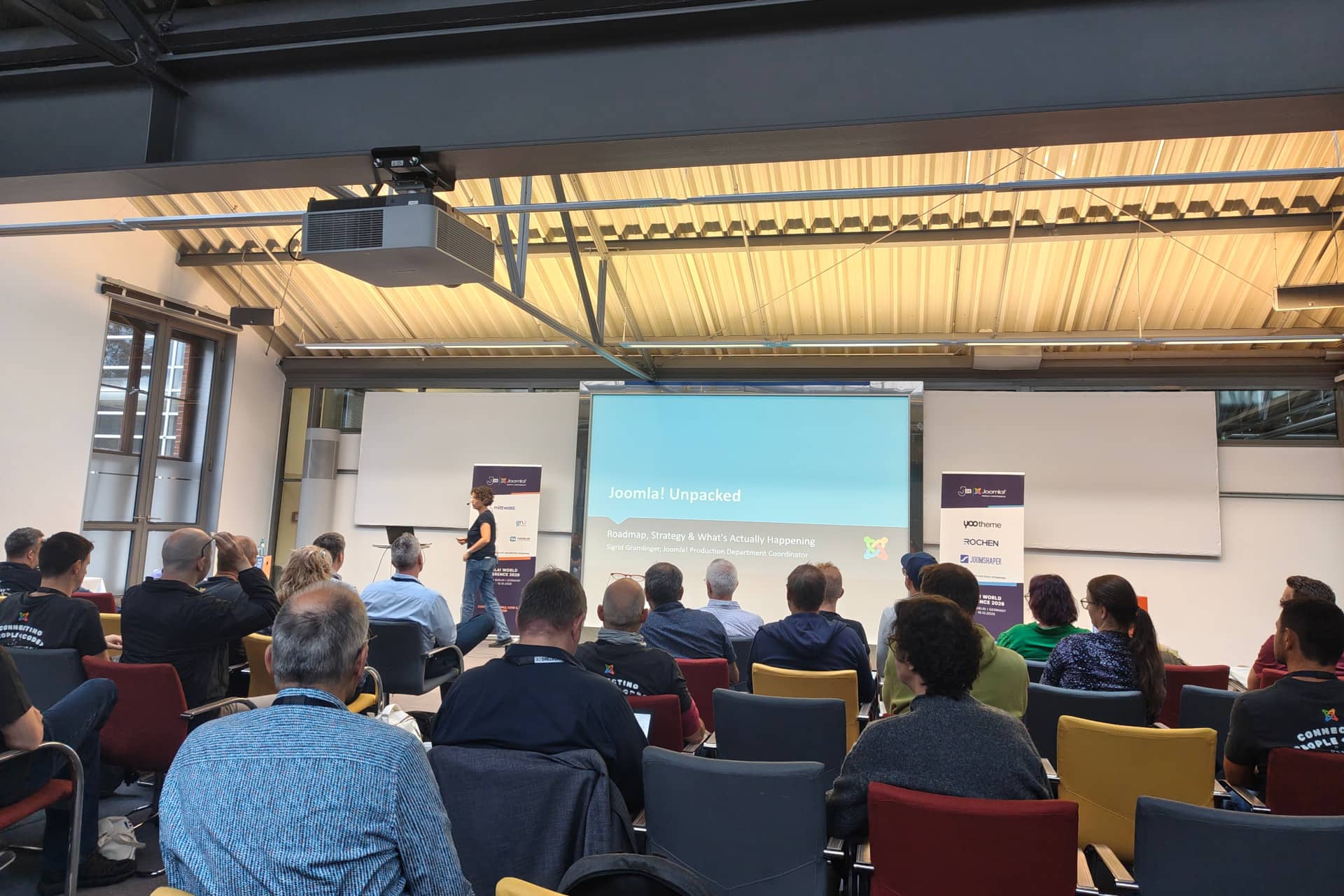
Keynote: Joomla Unpacked: Roadmap, Strategy & What's Actually Happening – Sigrid Gramlinger
Sigrid, coordinator of the Production Department, gave an honest look at the roadmap for Joomla 6, 7 and 8 that came out of the Joomla 8 sprint. She explained the strategy behind it and where things stand now. Good to get a clear picture of where Joomla is going.
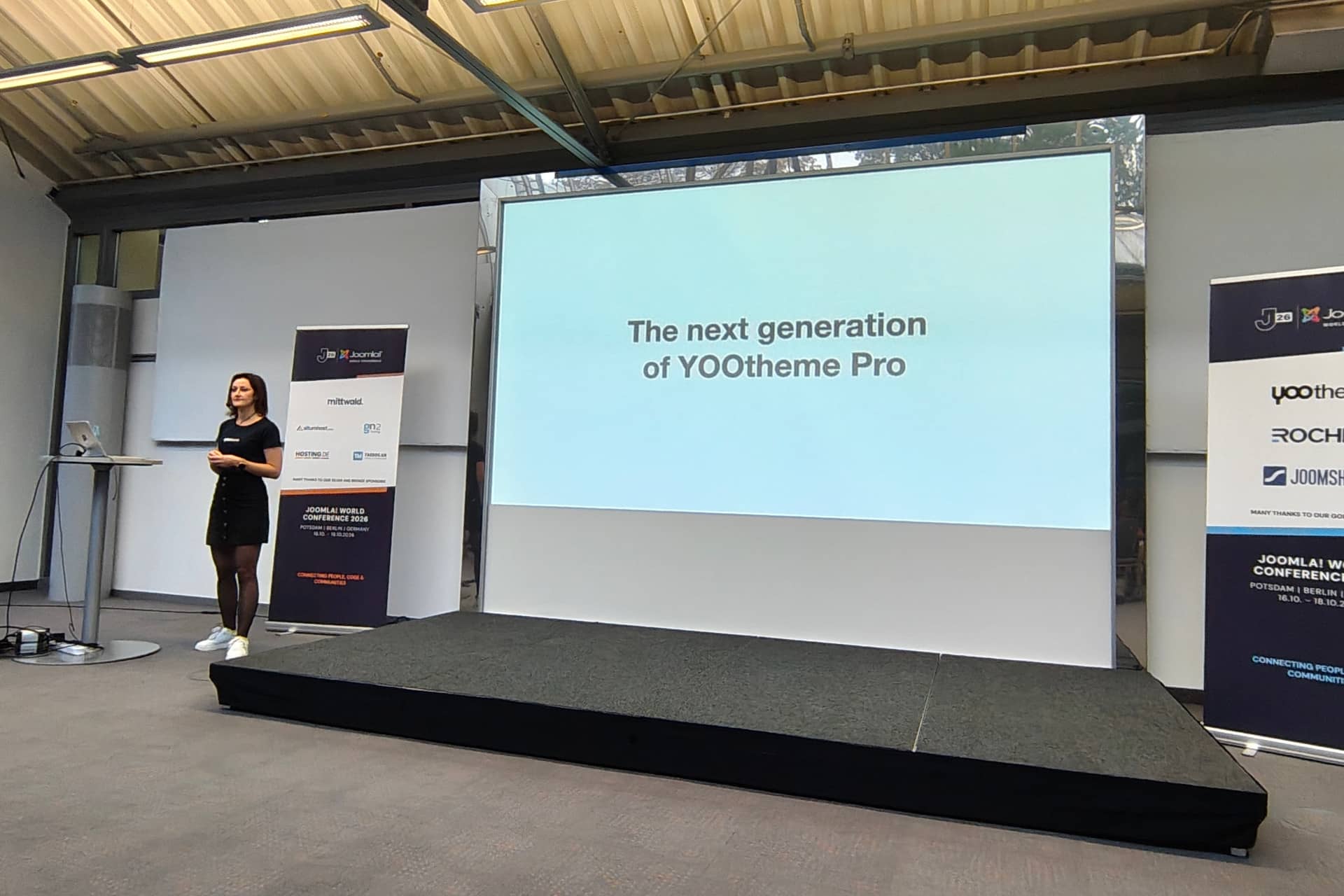
Next generation of YOOtheme Pro – Hanna Znanewitz
Hanna from YOOtheme showed a couple of new improvements that are coming in the next version of YOOtheme Pro. And there will also be an extra new feature: an MCP server for YOOtheme! With that you can connect any AI tool to YOOtheme. As a website builder who uses YOOtheme Pro a lot, I am curious to try that.
Bringing any API into YOOtheme – Thomas Venugopal (German)
The standard Sources in YOOtheme Pro do not always cover what real projects need, like a custom CRM, a booking system or services like Notion or Google. Thomas presented AnySource, a commercial extension which connects any REST or GraphQL API and shows the data as normal YOOtheme Sources. He built some several integrations live as demo.
Make it Happen
On Saturday afternoon, from 14:45 to 17:45, all four rooms were used for "Make it Happen": hands-on sessions where the Joomla teams invited everyone to help improve different parts of the Joomla software and the project. Think of documentation, bug squashing, accessibility testing, marketing, social media, certification and the Joomla MCP server.
The idea was not only to talk about improvements, but to actually make progress together. Everybody was welcome, from experienced contributors to complete newcomers. And you do not have to be a PHP developer to contribute to Joomla. Writing documentation, testing, translating, marketing or helping with social media is just as important.
I joined the Joomla MCP server session. There is already a proof of concept that lets an AI client read system information and clear the cache of a Joomla site. In the session we discussed the next steps to make it really useful.
During the session I also worked on the code myself. Until then, the MCP client tokens were stored as plain text in the database. So anyone with access to a database backup could use them. I made a pull request that stores the tokens the same way as Joomla's own API tokens: the database now only contains a random seed, and the real token is calculated with the secret key of the website. It was merged that same afternoon, before the session had even ended. That is what "Make it Happen" is about :-)
I'm looking forward to working with Joomla and YOOtheme Pro both with integrated MCP servers!
Sunday
Sunday was already the last day. The sessions I chose were about e-commerce, SEO and working with AI.
Turning Your Joomla Site Into a Million-Dollar Store – Olivier Buisard and Adam Melcher
Olivier and Adam presented J2Commerce, a native e-commerce extension for Joomla. They showed how businesses use it for multi-currency catalogues, subscriptions, B2B pricing and digital products, all inside one Joomla installation. They also compared it with Shopify, WooCommerce and Magento, and gave a preview of AI features for online stores.
Do you need Joomla SEO in an AI-world? – Yannick Gaultier
More and more people ask ChatGPT, Gemini, Claude or Perplexity instead of using a search engine. So, should you stop doing SEO? Yannick's answer: no, because SEO is still the basis for AI optimisation. AI assistants often use search engines to find current information, and there are only a few extra things you need to do specifically for AI.
My Colleague is an AI: The day my human assistant went to Australia – Philip Walton
When Philip's long-time assistant left for Australia, he did not hire and train a replacement. Instead he expanded the AI setup he was already using in his small Joomla agency. He showed his own web interface around Claude Code, a set of specialised assistants, and how he uses them for admin, research, content and Joomla development. It was a practical talk about automating parts of your workflow with AI agents, especially for people who tried AI tools before and thought "this does not work for me".
Unfortunately, I missed the closing session because I had to leave. My 8-hour train journey from Potsdam, Germany, back to Nijmegen, the Netherlands, was calling me...
The people
The presentations were very interesting, but for me the most valuable part of a conference like this is meeting people from all around the world. I saw Joomla friends again that I had not seen for quite a while. I also met people that I only knew from online discussions, and others that I had never talked to before.
During coffee breaks, lunches and dinners we talked about Joomla, our projects, technical problems and new ideas. And of course, we also talked about other things in life, like music, hobbies, family, our children and the challenges of raising kids in a world full of mobile phones and social media. Sometimes these conversations are just as useful as the presentations. What I like about the Joomla community is that people are happy to share their knowledge and help each other, whether you are a beginner or have been working with Joomla for many years.
Thank you
Many thanks to the organisation team, the speakers, the sponsors and all the volunteers who made this conference possible! And of course to everybody I talked to during these three days for the interesting conversations. I went home with new ideas, new contacts and a lot of energy to continue working with Joomla.
More information about the event and the presentations can be found on the Joomla World Conference 2026 website.
I hope to see you at the next Joomla event!