 Website
 Optimisation
 Support
 Training
 Blog
Blog db8
db8 Portfolio
 Reviews

SEO for AI: this is what happened after two months
In April 2026, I decided to use my own website, petermartin.nl, as a testing ground for SEO and GEO. It wasn’t a client project, but simply my own domain where I could experiment without bothering anyone.
The question I wanted to answer was: what happens if I write content not only for visitors and optimise it for Google SEO (Search Engine Optimisation), but also for the AI systems that are increasingly summarising, quoting and rephrasing that content (GEO: Generative Engine Optimisation)?
SEO for AI in practice: 170,000 impressions after five months
I have been building, optimising and providing technical support for Joomla websites since 2005. Since 2007, I have been working exclusively on Linux, including at my own workstation. In April 2026, I began systematically converting those twenty years of practical knowledge into knowledge articles on petermartin.nl. This article shows what that yielded in Google Search Console, how long it took, and, above all, what the figures do not prove.
The figures at a glance
Performance of the petermartin.nl website in Google Search Console, from 7 March to 6 September 2026
| Website | petermartin.nl (Joomla) |
|---|---|
| Measurement period | 7 March to 6 September 2026 |
| Start of experiment | end of April 2026, first articles on 28 and 29 April |
| Page views | 170,000 |
| Clicks | 820 |
| Average CTR | 0.5 per cent |
| Average position | 11.3 |
| Tipping point | around 30 May 2026 |
| Delay | approximately four to five weeks between publication and a visible increase |
| Current situation | consistently 1,500 to 2,000 impressions per day |
What exactly I have changed
The experiment on petermartin.nl consists of two parts, which I deliberately decided to carry out simultaneously.
- The first part focuses on content.
Since the end of April, I have been publishing a lot of unique, content-driven articles on topics I work with every day: Joomla, Linux and the web. These are not existing texts rewritten by an AI tool so that Google sees them as something new, but information derived from my own work as a Joomla specialist and Linux administrator. - The second part is technical.
Semantic HTML, structured data, a well-thought-out internal linking structure, good loading times and a site that is easy to crawl. These are the conditions under which the content can be found and understood in the first place.
In the first few weeks, I saw hardly any difference. About a month later, that changed significantly.
What does Google Search Console show?
The graph below shows the performance of the website petermartin.nl in Google Search Console over a six-month period. In March, April and the first half of May, impressions were so low that they are barely visible on this scale. The rise began around 30 May. By early June, peak days were around 4,000 impressions.
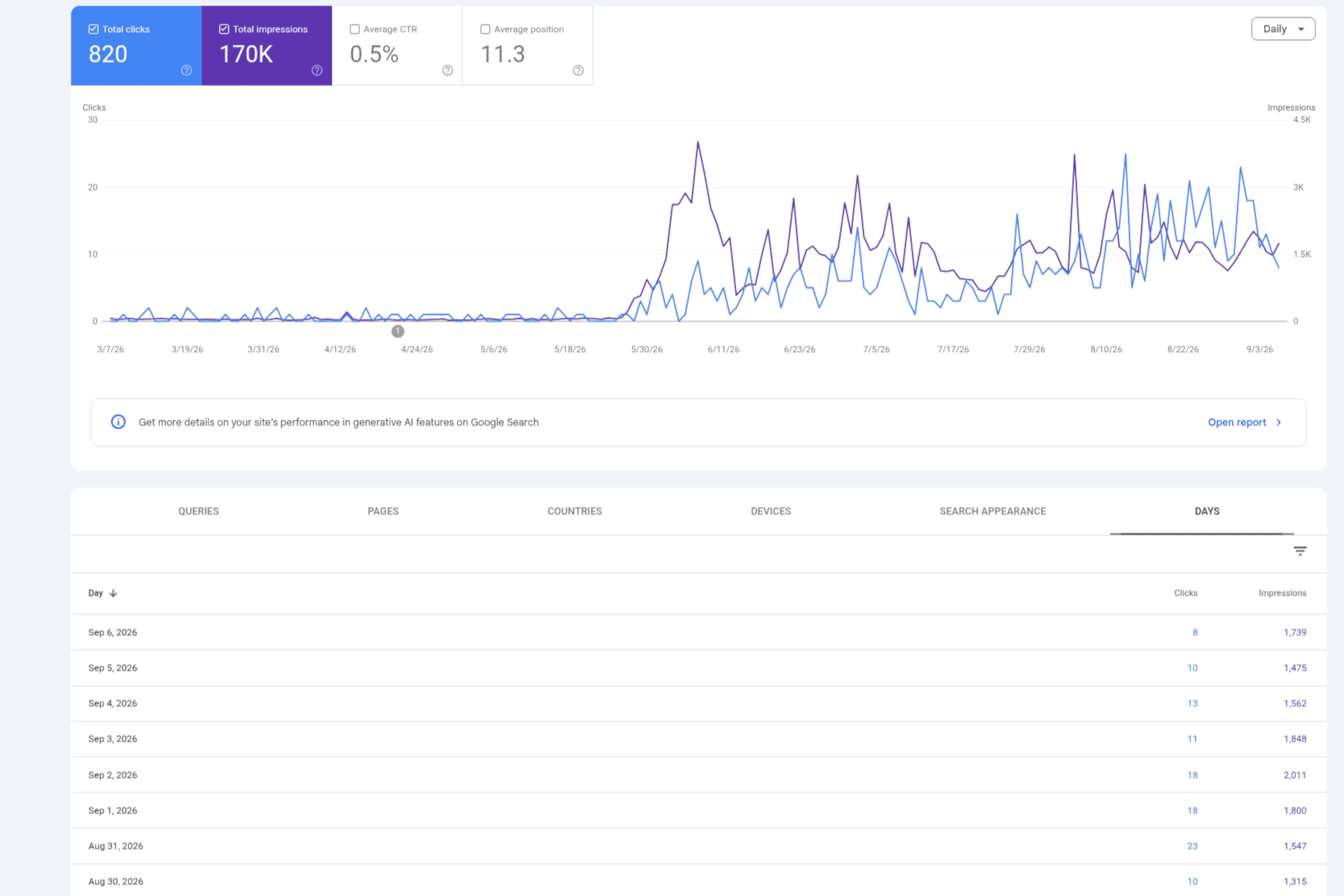
Over the entire period, petermartin.nl recorded 170,000 impressions and 820 clicks, with an average position of 11.3. What I find more interesting than those totals is the shape of the graph. In March and April, virtually nothing happens. Clicks fluctuate between zero and two per day, whilst impressions are so low that they hover just above the zero line. Around 30 May, the number of impressions begins to rise. From June onwards, the website appears much more frequently in the search results, with peak days of around 4,000 impressions.
In practical terms, this means that virtually all 170,000 impressions come from the last fourteen weeks of the measurement period. The first twelve weeks contribute almost nothing.
What do I mean by unique content?
By ‘unique content’, I explicitly do not mean that an existing article has been rewritten enough to count as a different piece of text. I try to publish information based on my own knowledge and experience, and to approach topics in a different way to existing tutorials.
Focus on Joomla
A good example is my series Focus on Joomla. In it, I don’t just explain how to do things in Joomla. I explain why Joomla works that way and how the different parts are connected. The articles start with concepts that website owners can follow, then become more technical for administrators, and, where relevant, conclude with information for developers. This results in topics that go beyond the usual user guide. Among other things, I write about Joomla’s architecture, the Web Services API, the CLI, workflows, action logs, authentication, templates, performance and the internal file structure.
The starting point is always the same: first understand why something exists; then the ‘how’ becomes much more logical.
Focus on Linux
I use the same approach for Focus op Linux. I have been using Linux exclusively since 2007, both on servers and on my own workstation, and I manage websites on it every day. There, too, I don’t want to create a collection of pages that simply list which commands someone needs to copy and paste. There are already thousands of websites that do that. I cover commands such as grep, find, rsync, chmod, ssh, systemctl, journalctl, dig and docker, but also the concepts behind them: the shell, the kernel, systemd, filesystems, DHCP and DNS resolution.
The aim is for readers not only to know which command is required, but also to understand what is happening in Linux. You can look up a command. If you understand why it works, you can also apply that knowledge when the problem is slightly different from the one in the tutorial.
Focus on The Web
The third section, featuring articles in English, is Focus on The Web. Behind every website lie all sorts of technologies that work together. Think of DNS, HTTP, HTML, CSS, JavaScript and security certificates. In this series, I explain how the web works and why certain technologies are used. Topics such as Google Search Console, Matomo Analytics and Google Business Profile are also covered.
My aim isn’t to produce yet another manual, but to provide insight into what happens behind the scenes. Because if you understand how the web works, you can solve problems more easily and make better choices for your website.
Why this approach also works for AI systems
AI systems have little use for yet another page that says more or less the same thing as a hundred other websites. Content that contains clear concepts, connections, context and concrete answers is far more interesting. That is what I deliberately focus on in my articles. Not by cramming texts full of terms that I think a language model will like, but by clearly defining topics and then explaining them thoroughly.
My approach is quite simple: don’t just write down the answer; also document the knowledge and experience behind it. This is useful for human visitors, whilst at the same time making an article easier for search engines and AI systems to interpret. There is also a practical side to it. AI systems rarely retrieve an entire page, but rather individual passages. A paragraph that only makes sense if you’ve read the previous two is therefore less useful than a paragraph that stands on its own. This means: naming topics explicitly rather than using ‘this’ and ‘that’, and including a heading that describes the question answered below it.
How long does it take for new articles to appear in Google?
For me, the delay is one of the most useful findings from this experiment. I started using this approach at the end of April 2026. The first Joomla articles were published on 28 and 29 April. More and more articles followed in May, and from June onwards the collection expanded rapidly. In the Search Console graph, the clear rise begins around 30 May.
So there was roughly a four- to five-week gap between them, and for the later articles, it was much longer. That’s useful information for anyone involved in SEO. After publishing an article, you can’t conclude after just a few days whether something is working or not. Google has to discover, crawl and index the page, then determine which search queries it might be relevant for, and after that, the page still has to prove itself amongst the other results.
Why I find 170,000 impressions more interesting than 820 clicks
My average CTR over the entire period is 0.5 per cent. You might conclude from this that not much is happening yet. I see it differently, for two reasons.
- The first is that this average is skewed by the early months. In the first week of September, 10,435 impressions generated 78 clicks. That is a CTR of just over 0.7 per cent, so about one and a half times higher than the average for the period. The figures for the last few weeks are simply better than the overall total suggests.
- The second reason is the position. An average of 11.3 roughly means: close, but not quite good enough. When some of the pages around that threshold move into the top 10, the number of clicks can increase much faster than the number of impressions.
It is worth noting, however, that this is something I still need to investigate myself. An average position of 11.3 with a CTR of 0.5 per cent usually indicates that the average does not present a homogeneous picture. It is likely that a small group of pages rank highly, whilst the majority of impressions are much lower down. Before drawing any conclusions about being ‘just outside the top 10’, I therefore want to examine that distribution on a per-page and per-search-query basis.
My next step is therefore to analyse which pages receive a lot of impressions, which search queries drive them, and which content ranks just outside the top positions.
What these figures do not prove
Google Search Console shows a correlation, not a cause-and-effect relationship. I find the timing interesting, to say the least, but there are several possible explanations and I cannot distinguish between them using this data.
- There is no control group. I have one website; this is not an A/B test.
- Content and technical aspects were addressed simultaneously. I do not know which part of the effect stems from which.
- Google itself also rolled out new updates during this period. The effect of these is inevitably reflected in the same graph.
- A larger number of pages naturally results in more impressions, even without any change in the quality per page.
- Impressions are not visitors, and visitors are not customers. It is an early indicator, nothing more.
What I will be measuring next
The title of this article is about AI, but all the figures above come from Google Search Console. I’m using them to show that my visibility on Google has increased. Whether AI systems actually pick up my articles requires a different set of metrics. That is the next phase of the experiment:
- Server logs relating to AI crawlers. Do GPTBot, OAI-SearchBot, ClaudeBot, PerplexityBot and Google-Extended visit the new articles, how often, and which ones?
- Referral traffic from chatgpt.com, perplexity.ai, claude.ai and copilot.microsoft.com in the statistics.
- The report on generative AI features that Google now offers in Search Console, so that impressions in AI Overviews and AI Mode are shown separately.
- Testing with specific questions on Joomla and Linux topics I’ve written about, to see if my site is mentioned or cited.
SEO and AI optimisation are becoming increasingly intertwined
What I personally find most interesting about this experiment is that I’m seeing less and less of a distinction between good SEO and good content for AI. In both cases, you’re trying to help machines understand what the information is about, whilst at the same time writing something that’s actually useful to a human. Technique alone isn’t enough for that. If twenty websites give the same answer and you publish answer number 21, why would your page be particularly interesting? That’s why I think personal knowledge and experience are becoming increasingly important. Not more content for the sake of having more content, but information that stems from experience, expertise and your own way of explaining things.
And now on to the next section
The experiment is far from over. The Joomla section has now been significantly expanded, the Linux series continues to grow, and with ‘Focus on The Web’ I’ve actually only just started writing articles on web technology. After all, what I’m really curious about is what happens when twenty years’ worth of practical knowledge is gradually transformed into structured, unique content that people, Google and AI systems can all understand.


