 Website
 Optimisation
 Support
 Training
 Blog
Blog db8
db8 Portfolio
 Reviews

JoomlaCamp 2026 in Essen, Germany
If you wanted to know where Joomla is heading in 2026, you only had to walk around at JoomlaCamp 2026 for two days. During this Joomla “unconference”, two themes stood out clearly: AI and smarter structuring
It was not an official theme, but it was the clear common thread in the sessions I attended.
JoomlaCamp at the Unperfekthaus in Essen (Germany), this year on Friday 27 and Saturday 28 February 2026, is an unconference.
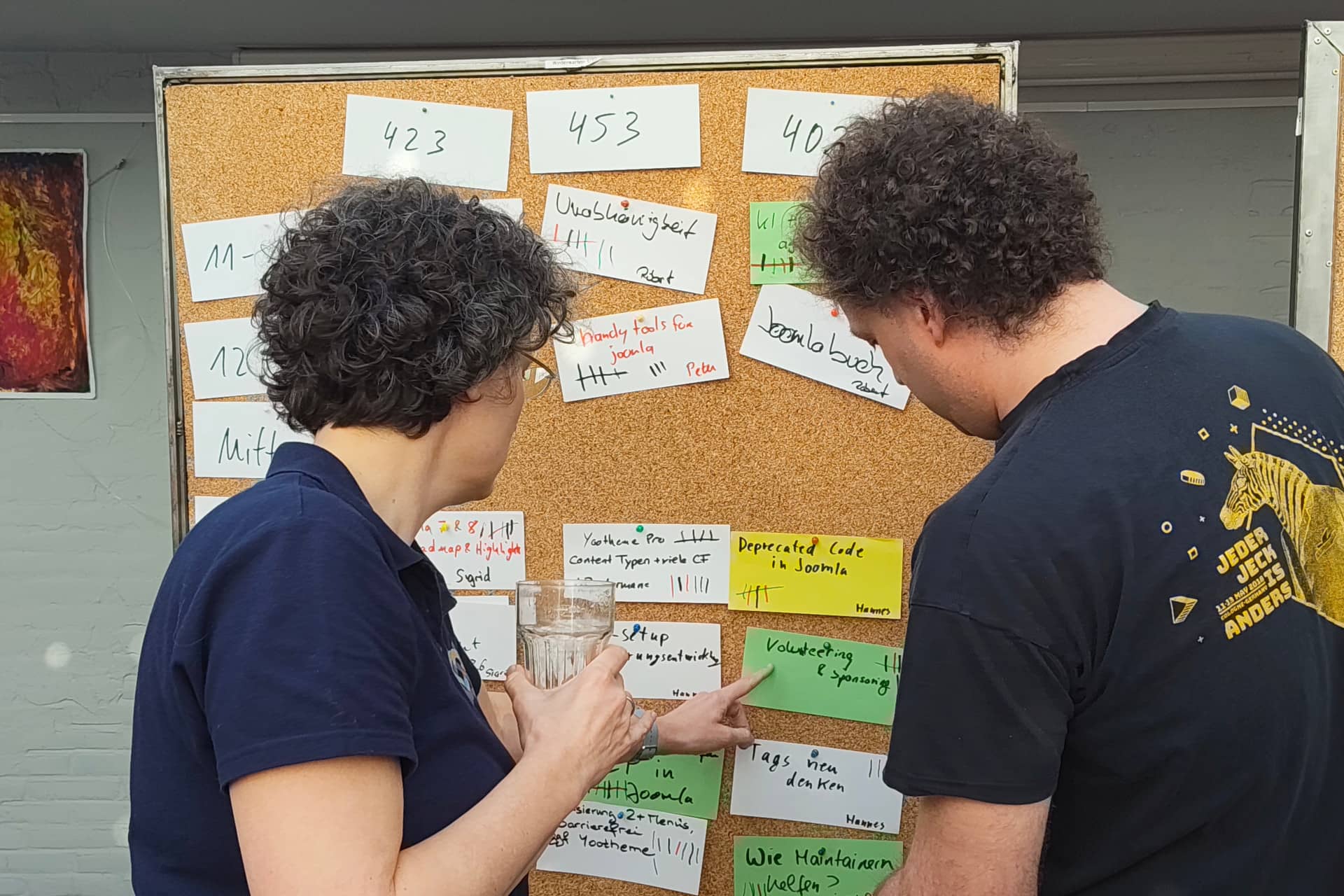 There is no fixed program in advance. Topics are proposed and selected on the spot in the morning. Within a short time, eighteen sessions were on the board, divided over six time slots in three rooms. This freedom makes it possible to choose your own focus. From 36 presentations in total (2 days x 6 time slots x 3 rooms).
Open source cookies
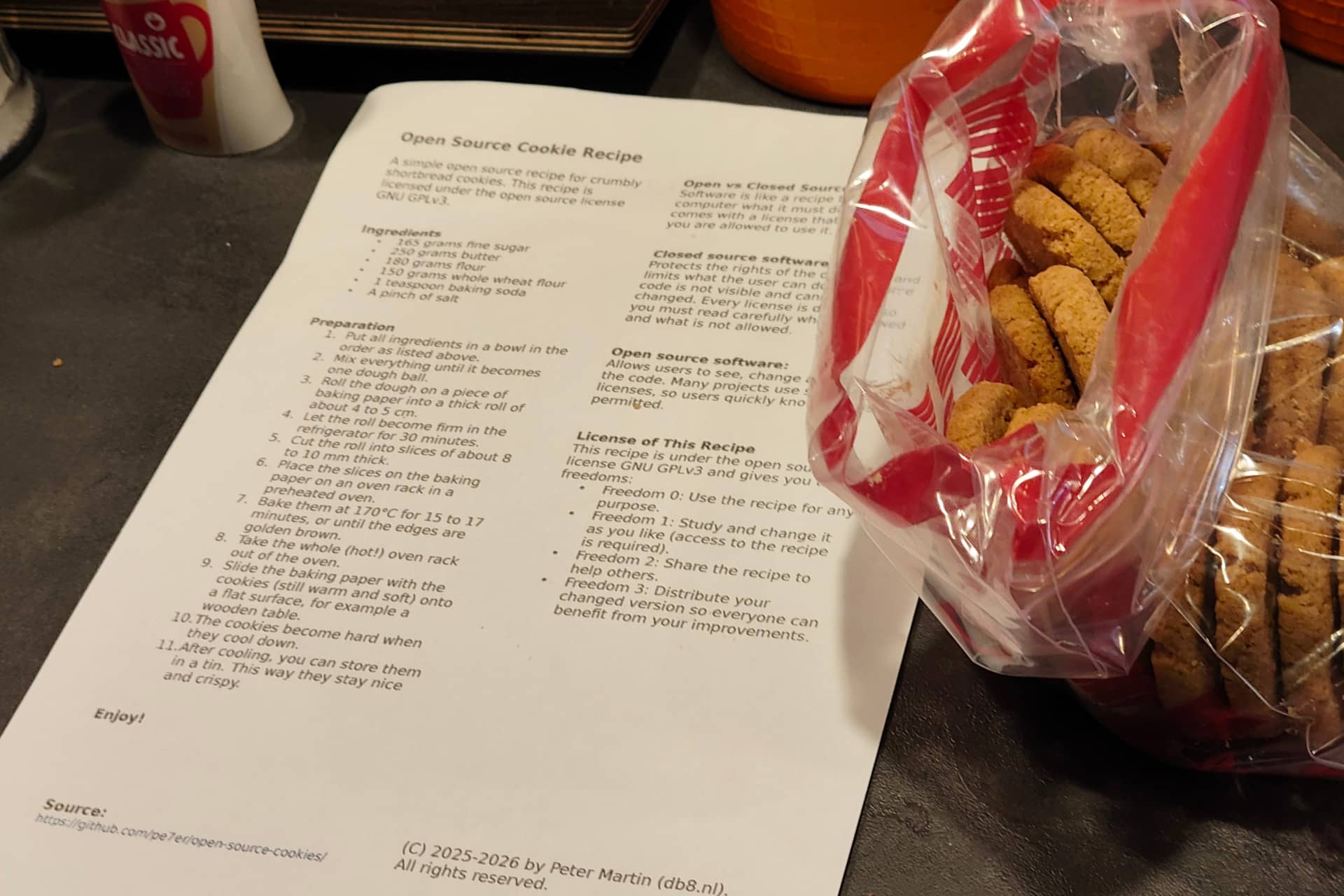 In previous years, I sometimes brought stroopwafels to international Joomla conferences. This Dutch cookie (two thin waffle layers joined by a sweet caramel filling) is often a big success in other countries. This year I decided to bring self-baked “open source cookies”: crispy shortbread cookies with recipe, ingredients list and a license. In a community that is built on open source, you do not need to explain “open source”, but it is still nice to make the principle tangible. The cookies were gone quickly, so it was a success.
Day 1: Business day
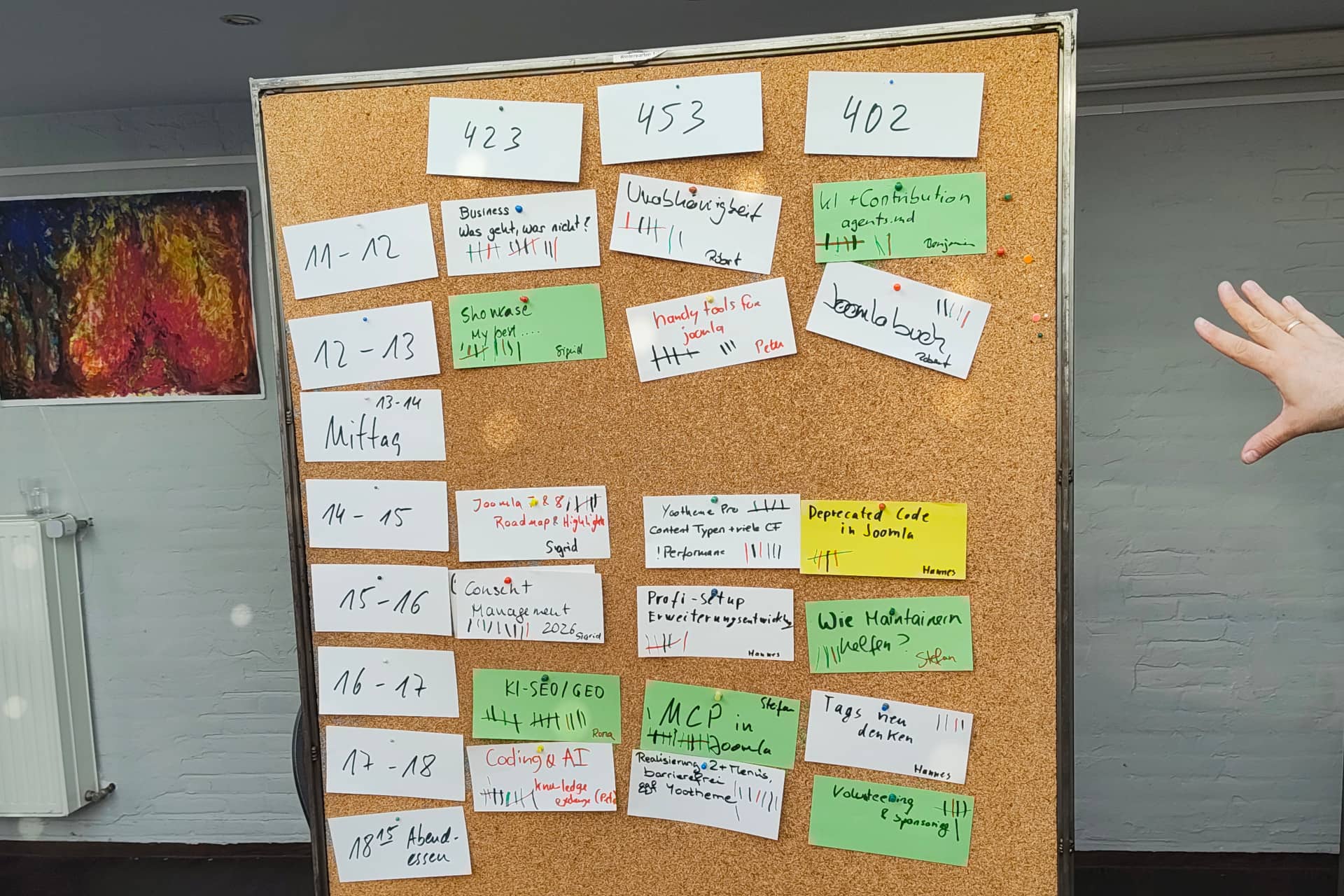
AI and contribution agents - Benjamin Trenkle
The first day immediately set the tone. Benjamin spoke about AI and contributing code to the Joomla core. He discussed the new AI policy of Joomla and agents.md as an open format to guide coding agents. The central question was: how do you use AI-generated code without reducing the quality and reliability of the project? The discussion was not about hype, but about responsibility.
Handy tools for Joomla - Peter Martin
In my own session, I showed which tools I use in Joomla projects: extensions, CLI tools, browser plugins, and deployment and debugging solutions. No theory, but concrete workflow choices for each development phase. The discussion that followed — with additions and alternatives from the audience — showed exactly why the unconference model works so well.
YOOtheme Pro: Content Types, Custom Fields & Performance - Ufuk Avci
Ufuk went deep into YOOtheme Pro, focusing on content types, custom fields and performance. For developers building more complex Joomla sites, it became clear how important data modeling and structured content are. Less ad-hoc building, more thinking about structure in advance.
Consent Management in 2026 - Sigrid Gramlinger
Sigrid started a discussion about consent management. Cookie banners, third-party scripts and legal pressure create tension between usability and compliance. Technology played a role here as well, but in the end it was about choices and responsibility.
MCP in Joomla - Stefan Wendhausen and David Jardin
Stefan and David presented the development of MCP functionality in Joomla. With MCP (Model Context Protocol), you can let AI models (such as Claude or ChatGPT) communicate directly with external data, tools and software. This makes AI-driven content management and more flexible integrations possible, independent from specific AI providers. It is a clear step towards a more open ecosystem.
Coding & AI - Peter Martin
In my second session, we exchanged experiences about using AI in software development. I shared how I use tools like Claude Code to analyze bugs and make older extensions compatible with Joomla 6. It was interesting to hear how others combine different models, for example one model like Claude Code for development and another like Codex (from OpenAI) for review. The conclusion: AI is a tool, not a replacement for craftsmanship.
Day 2: Community day
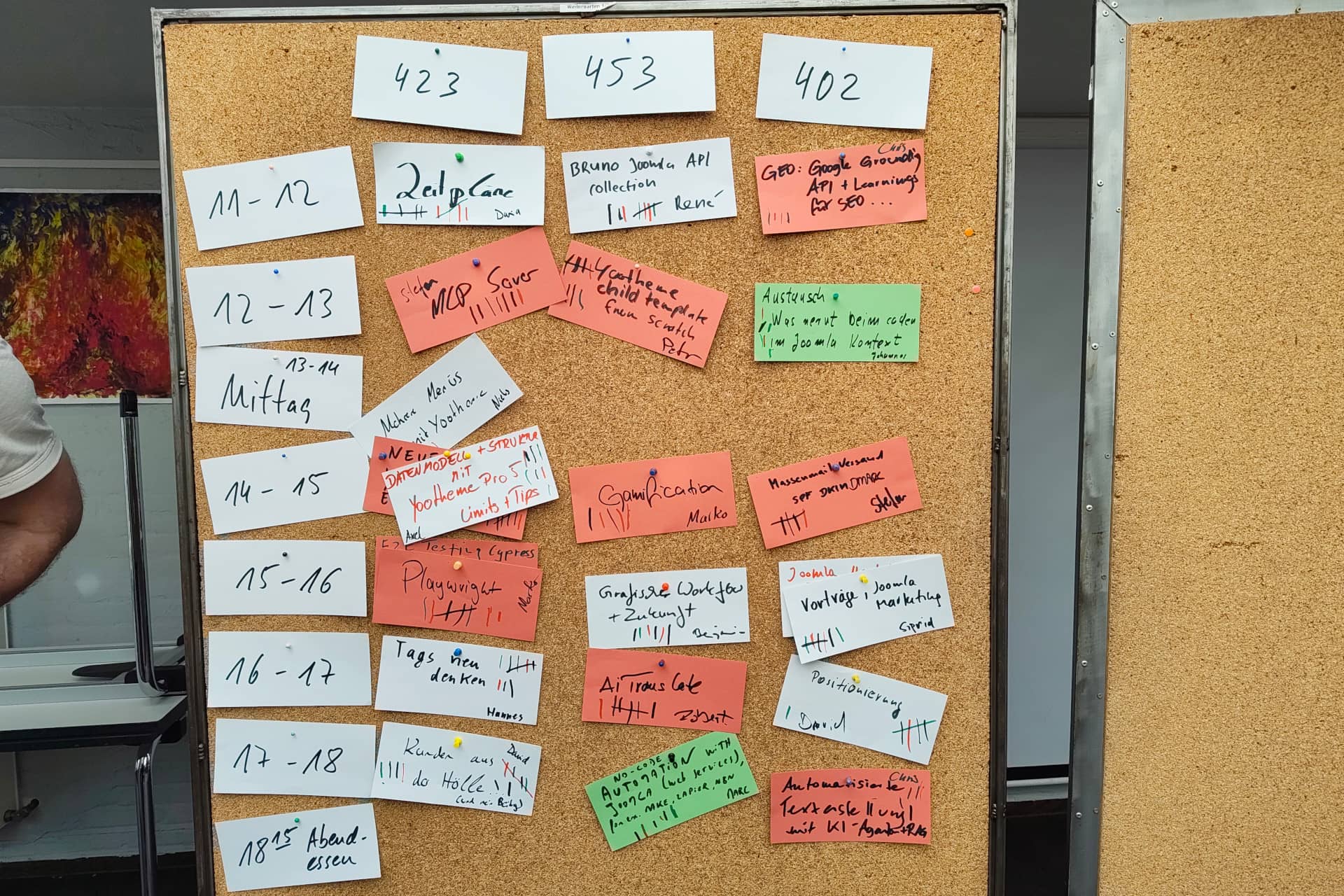
SEO, Google grounding - Christopher Wagner
Christopher discussed SEO and Google Discover. When you open Google Chrome on an Android phone, Google Discover shows articles based on your interests. Christopher showed that he developed an application to analyze visibility problems. Google Grounding was also discussed: connecting generative AI to reliable sources. The implication is clear: content and AI are becoming more and more connected.
YOOtheme child template from scratch - Peter Martin
In my session about building a YOOtheme child template from scratch, I explained why I prefer to work structured from the base instead of modifying an existing template. The discussion quickly moved to scalability, maintainability and smart CSS structures. The feedback from other participants was very valuable. Someone shared a tip on how to easily find placeholder classes that you can define in LESS to build your CSS later. It is great to give a session, share your knowledge, and still go home with new insights.
Datamodels and structuring with YOOtheme Pro 5 - Axel Hartmann
Axel showed how he built a complex site with YOOtheme Pro 5 and YOOtheme Essentials based on well-designed data models. His approach confirmed what came back in several sessions: structure wins from improvisation.
Playwright - Marko Feldmann
Marko demonstrated how he tests a WordPress installation with Playwright using a headless browser. Although it was another ecosystem, the principles were directly applicable. Testing and automation are becoming more important, also in Joomla projects. Joomla uses a different system for end-to-end tests: Cypress. I personally also use Playwright to quickly install backups in local test environments.
Positioning in the age of AI - Lukas Jardin
Lukas coordinated a group discussion with a broader perspective: what does AI mean for developers and designers? Where is the value shifting? The discussion was less about tools and more about roles and the future of our work as developers and designers.
Automation with Joomla - Marc Dechèvre
Marc showed how he uses Make and specific Joomla recipes to automatically publish articles from external sources via the Joomla API. Joomla becomes part of an automated ecosystem, not only a CMS, but a platform within a larger chain.
JoomlaCamp 2026
Although there were many more sessions, my focus this year was on AI and YOOtheme Pro. That was not a coincidence: in almost every discussion, automation, AI integration or structured content came back.
JoomlaCamp 2026 showed that Joomla is not standing still. AI is approached in a more serious and pragmatic way. At the same time, there is growing awareness that structure, data models and maintainability are crucial in a time when tooling becomes more powerful. Two days, many interesting conversations, and one clear conclusion: if you want to use Joomla in a future-proof way, you need to look beyond the CMS itself.
Curious how you can use AI and structured content in your Joomla projects? Feel free to contact us to discuss further.


